
Woodhouse Delivers on Rental Demand with Ontario's First Built Green Conversion
55 CORK meets critical housing needs, while supporting Guelph’s responsible growth objectives
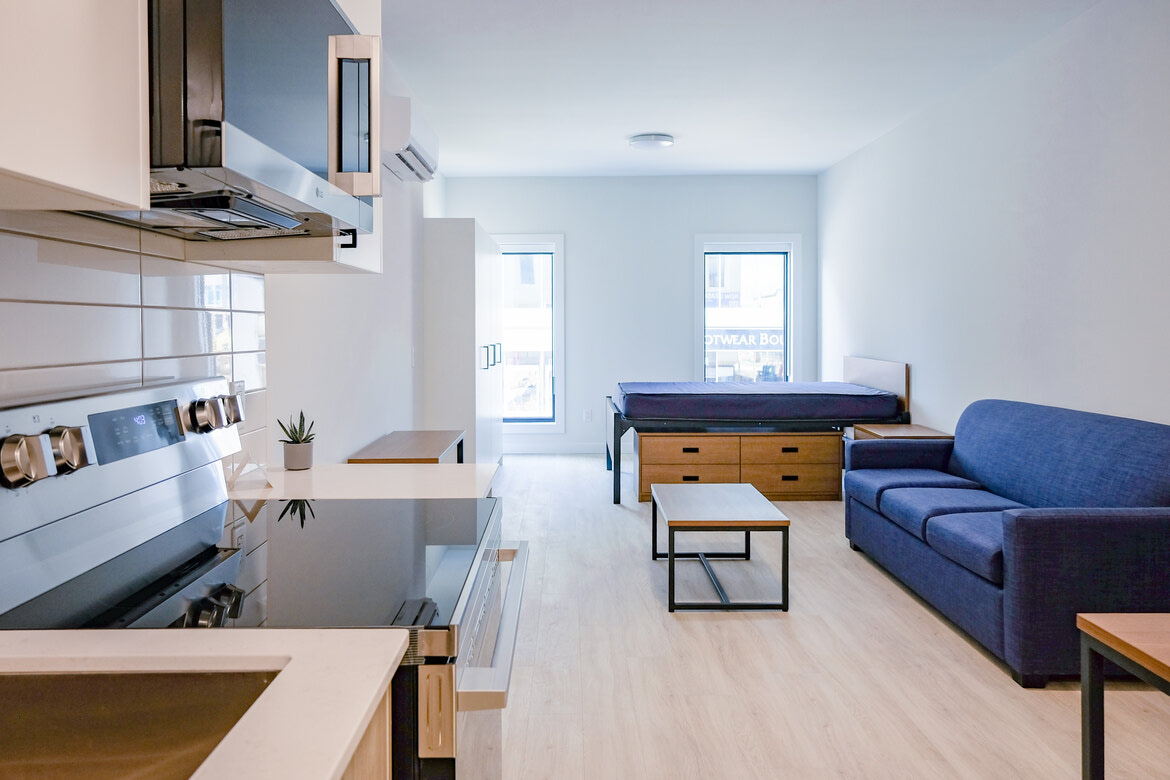
After 40 years, TD Bank in downtown Guelph closed its doors in 2023 and has sat empty since. That is until Woodhouse Group stepped in to give the space renewed purpose, while ushering in Ontario’s first Built Green certified conversion project of commercial-to-residential mixed-use: 55 CORK. As demand for rental units continues to outpace supply, this project has added 36 fully furnished and more sustainably built rental units to one of Guelph’s most walkable downtown locations.
The second-floor residents moved in early September, and the third-floor residents moved in early October; meanwhile, the commercial spaces on the main floor are taking shape and looking forward to grand openings in early 2027.
Guelph’s housing demands are shifting. According to the City of Guelph Housing Needs Assessment (HNA) from 2025, apartments are expected to make up the largest share of Guelph’s housing by 2051. In part, this is driven by demand from students and newcomers to Canada. Meanwhile, with an oversupply of large units, many are finding themselves over-housed. It’s expected that the need for smaller units and rentals in Guelph will only increase, and with 55 CORK’s mix of studio and one-bedroom layouts, this conversion supports housing needs, while delivering on the City’s historic and responsible objectives.
Downtown Guelph is undergoing a multi-year revitalization spanning infrastructure, commerce and culture. Recognizing 55 CORK’s contribution to the growth, development and future of downtown, former Mayor Cam Guthrie took a property tour and featured the project in his State of the City address, speaking to added vibrancy and giving buildings new life. This focus is reflected in the City’s Downtown Secondary Plan: a comprehensive vision for revitalization of their downtown core, reinforcing its historic character, while responsibly and creatively planning for growth.
In this vein, it’s recognized that conversions are a more sustainable choice. Reusing an existing building’s structure rather than fully demolishing and rebuilding, means lowered embodied carbon and construction waste, while conserving resources, as fewer raw materials are required.
However, commercial-to-residential conversions are not without challenges. They offer an avenue for addressing housing shortages, while meeting municipal guidelines like Guelph’s, yet inherent complexities can make the process far from straightforward. With structural and design constraints, environmental and community impacts, and legal and insurance issues—all contributing to economic considerations—it is not without a fair amount of willpower, experience and leadership that an organization like Woodhouse Group undergoes a project like 55 CORK.
This is their first project working through Built Green Canada’s third-party certification program, building on the Woodhouse sustainability portfolio, which already includes a seven-figure investment in solar energy; their AirProTech System for healthier indoor air quality; and achieving WELL Health-Safety Rating at select properties.
“Choosing to undergo Built Green certification reflects a thoughtful approach to redevelopment that prioritizes energy performance, environmental responsibility and long-term value,” says Woodhouse Group’s Chief Executive Officer, Joe Woodhouse. “At the end of the day, we want to create buildings that are better for the people who use them and the communities they’re apart of.”
55 CORK has achieved an impressive Built Green Platinum, reflecting energy performance far outstripping building code, while also addressing the program’s seven other pillars of sustainable building practices. This includes the preservation of natural resources, reduction of pollution and GHG emissions, ventilation and air quality, the improvement of home durability and more. Meanwhile, leaning into the occupant wellness focus shared by Built Green and Woodhouse, renters will have a shared lounge, workspace and library—while low-emission transport is encouraged with designated bike storage.
“We are continually inspired by industry leaders like Woodhouse, who work through the complexities associated with historic preservation and conversion projects for a more sustainable path forward,” says Jenifer Christenson, chief executive officer, Built Green Canada. “We’re gratified that Ontario’s first Built Green certified conversion is part of Woodhouse’s ongoing work to revitalize their community.”
Since Built Green Canada began over 20 years ago, builders have worked with the organization to complete over 61,870 BUILT GREEN® certified homes, buildings and communities represented in Alberta, British Columbia, Saskatchewan and Ontario (as at June 30, 2026).
Woodhouse Group is a third-generation, independently owned company operating across general contracting, disaster restoration and real estate. Since 1968, it has supported clients and communities throughout Waterloo Region and beyond by delivering projects and services that support the communities they serve with a shared commitment to leaving things better than they found them. They specialize in transforming under-utilized properties into places with purpose.